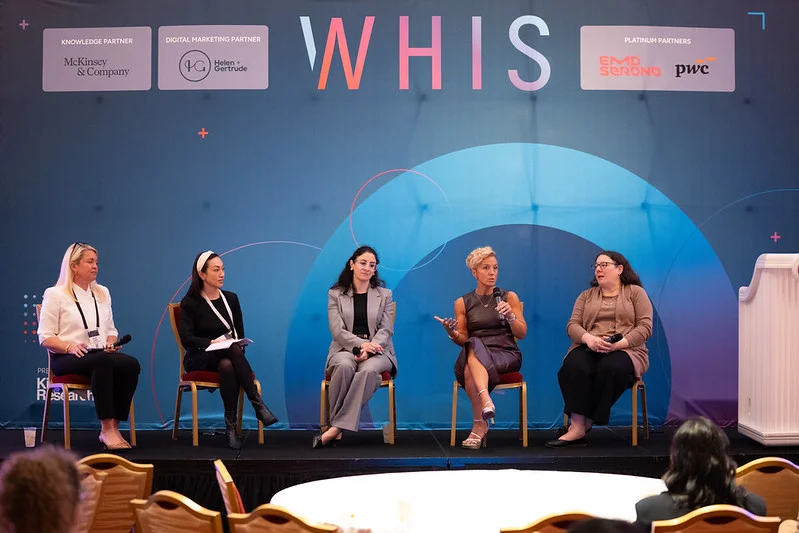
The access gap in women's health is the unmeasured space between a woman deciding she needs care and receiving it. At WHIS 2026, the industry focused on expanding care. The organizations that close the gap will be the ones that can measure where women get lost first: unanswered calls, abandoned inquiries and follow-ups that never get scheduled.
What We Heard at WHIS 2026
WHIS 2026 brought together leaders from across the women's health ecosystem to discuss how to move innovation from promising pilots to scalable care. Fertility, maternal health, menopause, screening, benefits, virtual care and AI all featured prominently.
"WHIS brought together an exceptional group of leaders who aren't just discussing the future of women's health, they're actively shaping it. The conversations reinforced something I believe strongly: innovation isn't only about advancing care. It's also about making that care easier for women to access."
— Maria Philips, Regional Vice President
What Is the Access Gap in Women's Health?
Healthcare often treats access as a question of availability: Is there a provider? Is the service covered? Is there an appointment? For patients, access is a journey. A woman has to find where to go, contact the practice, schedule, show up and often come back. At every step, she moves closer to care or disappears.
Consider the fertility inquiry that arrives after the office closes or the overdue patient on a recall list no one has time to work. These aren't failures of clinical medicine. They are access failures.
We call this the patient access blind spot: the largely unmeasured space between a patient's intention to seek care and her arrival in the care setting. Deloitte's analysis found that half of U.S. women skip or delay medical care because of cost, access or negative experiences. Women are 50 percent more likely than men to skip care because of long wait times, and 15 percent say it simply takes too long to get an appointment. Those aren't women who didn't want care. They are women who couldn't reach it.
Why the Gap Is Growing
Every new pathway into care, from a menopause clinic to an expanded screening guideline, adds to the operational load behind patient access in women's health. More patients mean more inquiries, more locations mean more routing complexity and more specialists mean more scheduling rules. Most of it lands on a front office that is already stretched.
The problem is rarely effort. It's capacity.
"When I look at a women's health platform, one of my first questions now is how many patients tried to reach them last month and didn't get through. Most can't answer it. You can't create value from a leak you can't see, so measurement has to come before automation."
— Maria Philips, Regional Vice President
The front office should be treated as part of the organization's care infrastructure, and leaders need to see where it is breaking before they decide how to fix it.
4 Questions to Measure Your Access Gap
Healthcare organizations measure an extraordinary amount of what happens after a patient enters the clinical system. Far fewer can say what happened before she got there. Here are four questions every women's health leader should be able to answer.
1. How many women tried to reach us last month?
Most organizations can tell you how many appointments they booked. Far fewer can tell you how many women tried to book one. The gap is bigger than most leaders expect: industry benchmarks show that missed patient calls average about 23 percent of incoming calls, and as many as 42 percent at peak hours.
Ask your team: How many inbound contact attempts did we receive last month, across every location and channel, and how many reached a person or a scheduled outcome?
Red flag: Your phone system tracks abandoned calls and hold time, but it's difficult to review them by location, and voicemails, portal messages and web forms are often missed.
2. Why were they calling?
In women's health, most call reasons are routine: a fertility inquiry, a mammogram to reschedule, a question about coverage. None of it requires clinical judgment. But when call reasons live in front-desk memory instead of data, you can't tell which ones are leaking.
Ask your team: What are our top call reasons by location, and how did each one end: booked, resolved or dropped?
Red flag: Call reasons being tracked only from IVR menu choices. Knowing a caller pressed 1 for appointments doesn't tell you whether she was able to book one or how many times she was transferred.
3. How many gave up before they got through?
Abandoned calls, unreturned voicemails, portal messages that sat overnight. Each one is a patient who moved toward care and then stopped. Losses cluster by location, hour and call type. After-hours inquiries are the classic example: the moment of highest intent is often the moment the office is closed.
Ask your team: What is our abandonment rate by location and time of day, and how many after-hours inquiries get a response before the patient goes elsewhere?
Red flag: One blended abandonment number for the whole system. Averages hide the locations that are quietly losing women.
4. How many were supposed to schedule, and never did?
This is the hardest gap to see and the most costly: the overdue patient on a recall list, or the patient with an abnormal result whose diagnostic visit is waiting in a queue. In a systematic review of follow-up after abnormal screening mammograms, reported rates of failure to follow up within three months ranged from about 7 to 33 percent. Behind each number is a gap in the process, not a decision the patient made.
Ask your team: How many patients have an open recommendation, such as a screening or diagnostic follow-up, with no scheduled appointment, and who owns working that list?
Red flag: The list exists, but nobody is assigned to work through it.
Score yourself. Give your organization one point for every question you can answer with data rather than a guess. 0 to 1: you're flying blind. 2 to 3: you can see part of the journey. 4: you can see the whole gap.
Measure First, Then Automate
Once you're able to gather the analytics and can see the gap, the conversation about automation changes. The question isn't how many patient interactions can be automated. It's where technology can responsibly remove friction between a woman and her care.
Scheduling, reminders and after-hours inquiries consume significant capacity without requiring clinical judgment. Used appropriately, AI patient access tools can handle those interactions and escalate the moments that need human expertise and empathy. The goal isn't to remove people from women's health. It's to preserve their time for the interactions where people are needed the most.
At Aqurio, we believe meaningful automation begins with understanding the patient experience. Before organizations can improve access, they need visibility into where patients encounter friction, why they're reaching out, and whether their needs are being resolved. Our SmartAnalytics provides real-time insight into 100% of patient interactions, revealing where calls go unanswered, where patients are transferred unnecessarily, and where opportunities to connect women with care are being missed. With that intelligence, our SmartAgent can help address those gaps by managing inbound calls around the clock and scheduling appointments directly within existing systems, while our SmartEngage supports ongoing communication through reminders and follow-up scheduling. Together, these capabilities help women's health organizations move from simply managing patient interactions to understanding and improving the entire access experience, all while keeping clinical decisions firmly in the hands of healthcare professionals.
Women's health will keep producing important innovation. But innovation can't close the gap if women struggle to reach it. An unanswered call, an appointment that's hard to schedule or a follow-up stuck in a queue may look administrative from inside a healthcare organization.
To the patient, they are healthcare.
And the next breakthrough in women's health may be making the care we already have easier to reach.
Which of the four questions can your organization answer today? Tell us on LinkedIn.
Frequently Asked Questions
What is the access gap in women's health?
Why do women skip or delay medical care?
What were the main themes at WHIS 2026?
What should women's health organizations measure first?
How many patient calls do medical practices miss?
What happens when follow-up after an abnormal mammogram is missed?
Can AI improve patient access without replacing staff?
Sources: Deloitte Insights, "Why US women skip or delay health care"; Patient Prism, "Average Call Abandonment Rate in Healthcare, 2026 Benchmarks"; "Delayed or failure to follow-up abnormal breast cancer screening mammograms in primary care: a systematic review" (PMC).